Reiki in a Busy Life: Why a Few Minutes of Practice Still Matter

There are times in life when Reiki seems to flow naturally through our days. We make time for our self-treatment, settle into our familiar hand positions, and enjoy the stillness that comes with giving ourselves that time.
And then life happens.
Work becomes busy. Family needs our attention. Our routines change. We feel tired, distracted or overwhelmed, and the practice that once felt so natural slowly slips into the background.
Days become weeks, and sometimes months.
Eventually, we may begin to wonder whether we've lost our sensitivity to Reiki. We question whether we can return to our practice after so much time away. Perhaps we tell ourselves that we'll begin again when life settles down, when we have more time, or when we can finally find the peace we think we need.
But what if we're making returning to Reiki harder than it needs to be?
What we imagine we need, and what we really need
Sometimes, we imagine that returning to Reiki means returning to the way we practised before.
We picture a quiet room, a comfortable space, perhaps a candle, gentle music and enough uninterrupted time to move through all twelve hand positions. We want to feel relaxed, focused and connected before we even begin.
There is nothing wrong with enjoying these things. A full self-Reiki treatment can be a beautiful way to care for ourselves, and making dedicated time for our practice is valuable.
But when we believe these conditions are necessary every time, we can unintentionally create a barrier between ourselves and the practice we want to return to.
We begin to think that if we cannot do everything, there is little point in doing anything.
Yet sometimes, what we really need is simply to begin.
A few quiet breaths. Our hands resting over our heart. A moment of gratitude. A gentle intention to reconnect with Reiki before we continue with the day.
It may not be the same as a full self-Reiki treatment, and it doesn't need to replace one. It is simply a way of keeping a little space for Reiki in a life that doesn't always leave much room for stillness.
You don't have to feel peaceful to practise Reiki
One of the things that can make returning to Reiki difficult is the belief that we need to feel calm before we begin.
We may think we need to quiet our minds, release our worries and create the right atmosphere before we can connect with our practice.
But life doesn't always give us those conditions.
Sometimes we are anxious about a deadline. Sometimes the house is noisy, the children need us, or our minds are full of everything we haven't managed to do. Sometimes we are simply tired.
These are not necessarily reasons to turn away from Reiki. They may be the very moments when we want to make a little space for ourselves.
You can sit quietly for a moment in the middle of a busy day. You can rest your hands over your heart before getting out of bed. You can take a few mindful breaths and reconnect with your intention while waiting for the kettle to boil.
You don't have to make the moment perfect.
You only have to allow yourself to be present in it.
What if you've lost your sensitivity to Reiki?
After time away from our practice, we may worry that we no longer feel the sensations we once experienced.
Perhaps our hands don't seem as warm. Perhaps we don't notice the same tingling, pulsing or sense of energy. Perhaps we remember how connected we felt before and wonder why it seems different now.
It can be discouraging, especially when we believe that these sensations are evidence that our practice is working.
But our experiences of Reiki can vary. We may notice different sensations at different times, and sometimes we may notice very little at all.
The absence of a particular sensation doesn't mean you have failed, nor does it prove that you've lost your connection with Reiki.
Rather than trying to recreate an experience from the past, allow yourself to meet your practice as it is today.
You don't need to force a sensation or measure your progress against what you once felt.
Return with curiosity. Give yourself permission to begin again without expectations.
Sometimes, the most helpful thing we can do is stop asking whether we are doing enough and simply allow ourselves to practise.
Let your daily Reiki practice change with you
There may be days when you have the time and space to move through all twelve hand positions. You can settle into a full self-treatment, enjoy the stillness and give yourself that dedicated time.
Other days, you may only have a few minutes.
Perhaps you place your hands over your heart before beginning work. Perhaps you rest them over your abdomen while sitting quietly in the evening. Perhaps you choose one position that feels comfortable and stay there for a few mindful breaths.
And some days, you may simply pause, bring your awareness to Reiki and offer a moment of gratitude.
These different moments don't need to compete with one another.
A shorter practice is not a substitute for every aspect of a full treatment, but it can help you maintain a relationship with your Reiki practice when time is limited. It can make returning feel more accessible, rather than something you must prepare for or get perfectly right.
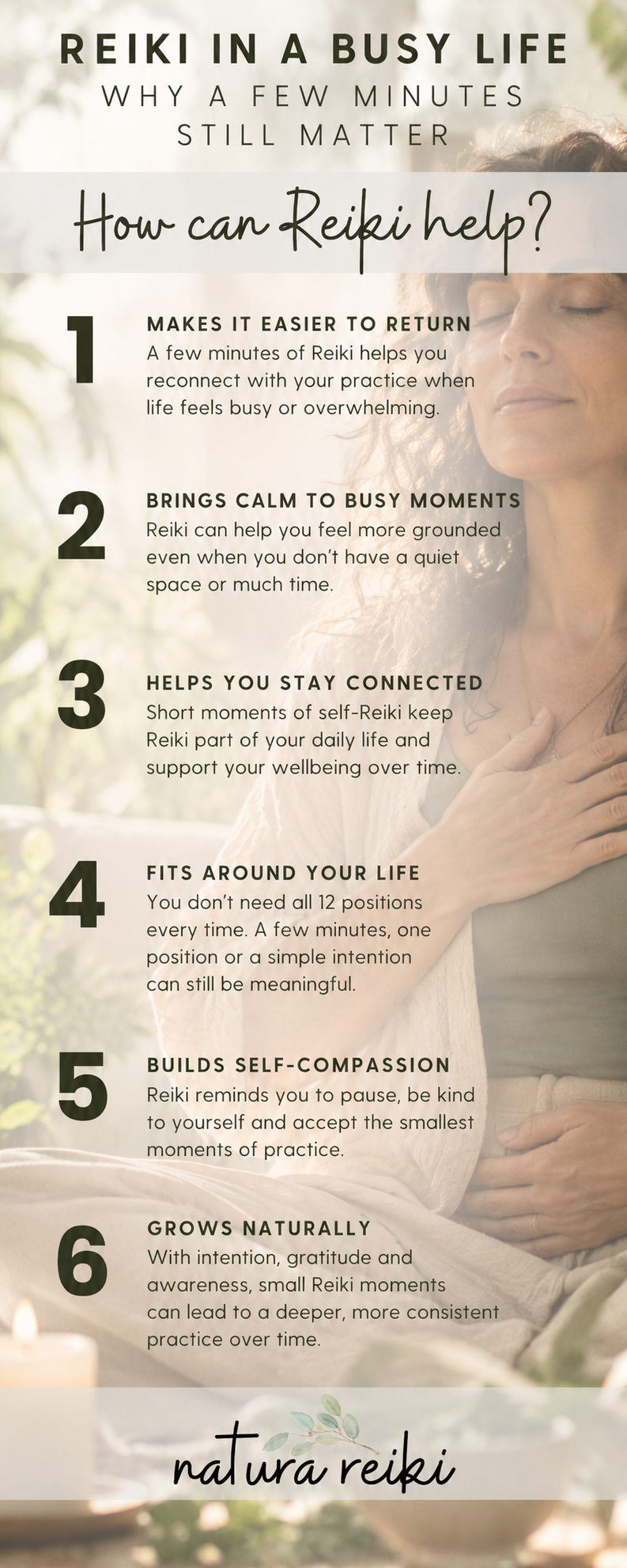
Let your practice fit your life, rather than waiting for your life to fit your practice.
This is not about lowering your standards or abandoning the deeper practice you value. It is about creating flexibility, so that a busy period doesn't have to become a reason to give up altogether.
Reiki on the move: bringing intention into ordinary moments
One of the simplest ways to make Reiki part of everyday life is to stop thinking of practice as something that can happen only in one particular place.
Your usual treatment space can remain important. It can be somewhere you return to when you have the time and desire for a longer session.
But your connection with your practice can also be supported by small, intentional moments throughout the day.
You might:
Begin the morning by placing your hands over your heart and setting an intention for the day.
Pause for a few breaths before opening your emails or starting a demanding task.
Rest your hands comfortably on your lap and take a moment to reconnect with your Reiki practice.
Offer yourself a short moment of gratitude before going to sleep.
Return to one familiar hand position when you notice that you have been rushing through the day without a pause.
If you have been attuned to Reiki symbols, you can incorporate them in accordance with your training and tradition.
There is no need to turn every spare moment into another task on your to-do list. These moments are invitations, not obligations.
The aim is not to practise constantly. It is to make returning feel possible.
When life gives you lemons
There will always be seasons when life asks more of us than we expected.
We may have family responsibilities, work pressures, changes in our health or periods when our emotional energy feels stretched. Even the routines that once supported us can become difficult to maintain.
During these times, it is easy to become frustrated with ourselves. We remember what our practice used to look like and feel disappointed that we cannot manage the same thing now.
But we are not living the same day, month or season of life.
Our needs change. Our available time changes. Our energy changes.
Perhaps our practice can change with us, too.
Instead of seeing a short practice as evidence that we are falling behind, we can see it as a gentle way of keeping the door open.
We can choose to meet ourselves where we are, rather than waiting until we become the person we think we should be before we begin again.
And when life becomes quieter, we may find that returning to a longer practice feels more natural because we never made the smaller moments something to be ashamed of.
An intention for returning to Reiki
If you have been away from your practice, you don't need to make a complicated plan or promise yourself that you will practise perfectly from now on.
You might begin with a simple intention:
I welcome Reiki back into my daily life. I allow my practice to meet me where I am, and I am grateful for every moment I can give to it, however small.
Take a comfortable breath. If it feels right for you, bring your hands together in Gassho or rest them over your heart.
Allow yourself a moment of awareness. You don't need to feel anything particular. You don't need to achieve anything.
Simply give yourself permission to begin again.
Tomorrow, you might have five minutes. Another day, you might have thirty. On a particularly difficult day, your practice might be no more than a brief pause and an intention to reconnect.
Let that be enough for this moment.
Over time, these small moments may help you rebuild a rhythm that feels natural and sustainable. They may grow into longer treatments, deeper reflection and a renewed place for Reiki in your everyday life.
Not because you forced yourself to do more, but because you made it easier to return.
You can always begin again
Reiki doesn't have to exist only in the quiet spaces we create away from the world. We can make room for dedicated self-treatment while also finding gentle ways to reconnect with our practice amid the ordinary demands of life.
You haven't necessarily lost your sensitivity because you've been busy. You don't need to recreate your old routine overnight, and you don't need to wait for everything to be perfect.
Begin with what you have. Begin where you are.
A few minutes of intention, awareness and gratitude may seem small, but small beginnings can help us rediscover a practice that matters to us.
You don't have to wait for life to slow down to make room for Reiki. You can begin with one moment, right where you are.
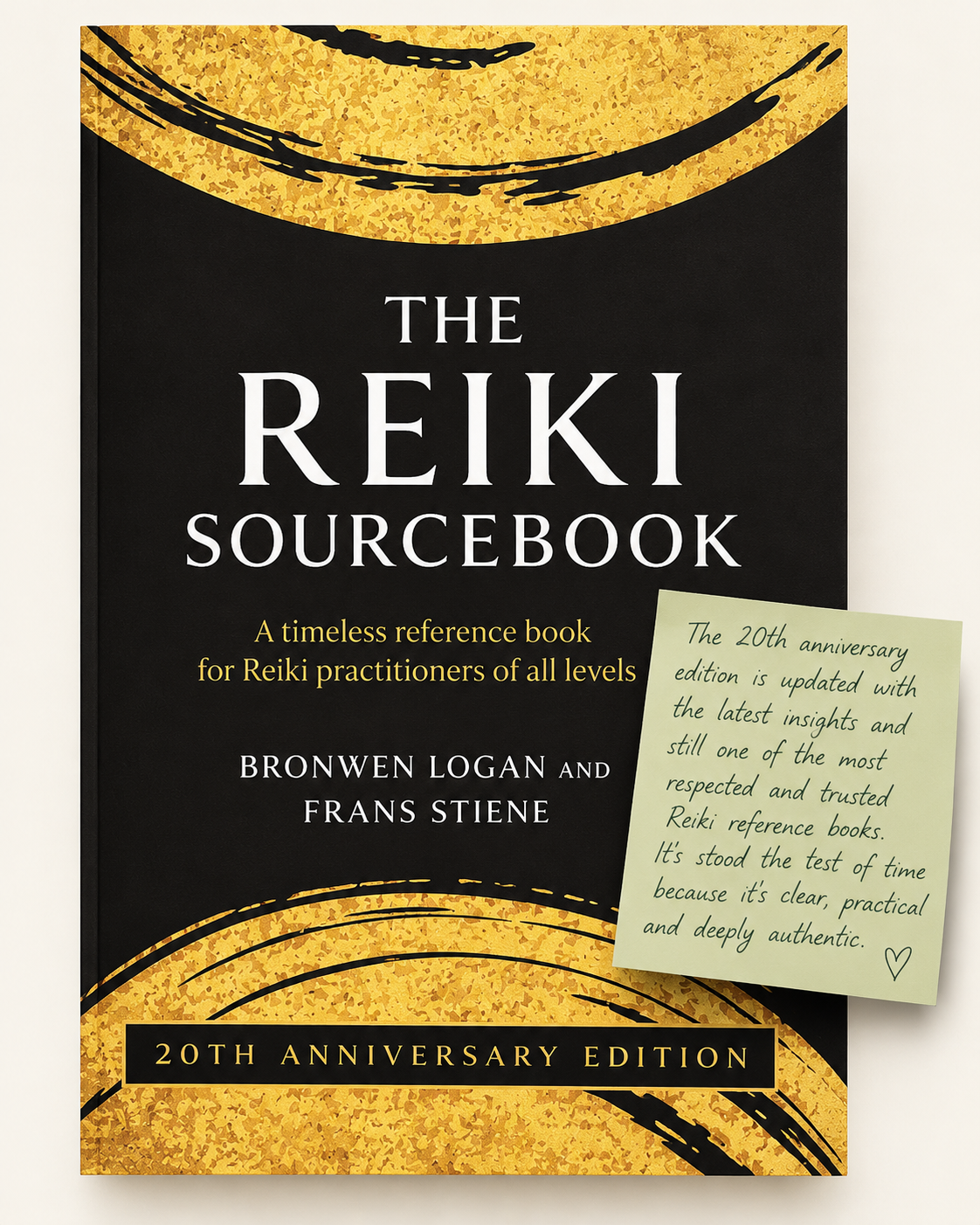
A book to deepen your Reiki practice
If you're looking to reconnect with your Reiki practice or deepen your understanding of this beautiful tradition, The Reiki Sourcebook by Frans and Bronwen Stiene is worth exploring. It offers a detailed reference for Reiki practitioners who want to learn more about Reiki's history, principles and practice.
Remember, though, that you don't need another book, a new technique or the perfect routine to begin again. Sometimes, the most meaningful step is simply placing your hands gently over your heart and allowing yourself a moment of connection. See it here
Affiliate disclosure: This post contains affiliate links. If you purchase through my link, I may earn a small commission at no extra cost to you.