The Exhausted Reiki Practitioner’s Guide to Self-Care
There is a very specific kind of exhaustion that comes from being “the calm one.” You know the one.
The person who remembers everyone’s appointments and answers messages with warmth at 10:47 pm. The person who is worrying about clients’ needs while simultaneously wondering if there’s anything in the fridge besides half a cucumber and oat milk from three weeks ago.
As Reiki practitioners, we become wonderfully skilled at sensing the needs of others. Sometimes so skilled, in fact, that we can identify a client’s blocked throat chakra from three postcodes away… while completely ignoring our own need for water, protein, sunlight, and a sit-down.
And then comes the evening self-Reiki session. Our sanctuary.
The candles are lit.
The blanket is soft.
The 21-minute healing soundtrack is playing beautifully in the background.
The ocean waves are whispering.
The frequencies are frequency-ing.
Five minutes later?
Unconscious.
Gone.
Spiritually horizontal.
Honestly, I used to feel slightly guilty about this. I’d think: “I didn’t complete the session properly.” But over time, I’ve started to see it differently. Because perhaps Reiki knew exactly what I needed.
Not another task or thing to “complete.” Not a gold star for spiritual productivity. Maybe what I actually needed… was sleep.
And frankly, after a long day of holding space for everyone else, being lovingly escorted to Dreamland by Reiki energy itself is not exactly a failure. In many ways, it’s the healing.
Research around caregiver burnout and nervous system stress consistently shows that people in helping roles often remain stuck in a prolonged stress response, which affects sleep, recovery, mood, and energy regulation. Brief rest practices and nervous system regulation can significantly reduce stress and restore mental clarity. (healthyselfswfl.com)
Reiki practitioners are not immune to this simply because we own crystals and know where our chakras are.
If anything, we are sometimes more prone to over-giving.
A 2023 paper on Reiki as a self-care practice highlighted that even short Reiki sessions can reduce stress and feelings of overwhelm in caregivers and practitioners. (ScienceDirect)
Which brings me to something important:
Your energetic health routine should support your real life. Not your fantasy life.
Your fantasy life says:
You rise at 5 am.
Meditate for an hour.
Journal poetically beside a lemon water.
Practice yoga at sunrise.
Consume organic sprouts with spiritual discipline.
Your real life says:
Someone needs something.
Your inbox has multiplied.
The dog is barking.
You forgot to defrost dinner.
You’ve accidentally reheated the same tea three times.
A sustainable energetic routine must fit the person you actually are.
Not the woman from Pinterest who apparently lives in a silent Scandinavian cabin with no responsibilities and suspiciously good linen trousers.
So what actually helps?
1. Stop treating self-Reiki like homework
This was a big one for me. Somewhere along the line, self-care became another performance metric.
If we didn’t do the full 21 minutes, sit upright, stay focused, remember all hand positions, and emerge glowing like an enlightened Victorian saint… we felt we’d somehow failed. No.
A three-minute hand-on-heart Reiki moment while waiting for the kettle counts. Falling asleep during Reiki counts. Listening to healing music while horizontal and emotionally cooked absolutely counts.
Reiki is not judging you from the astral realm with a clipboard.
2. Create “micro-moments” instead of waiting for perfection
One of the most helpful things researchers now emphasise for caregivers and people in helping professions is that small, regular nervous system resets work better than waiting for the occasional perfect self-care day. (ScienceDirect)
This changes everything.
Instead of: “I must do a perfect 45-minute healing session tonight.”
Try:
One minute of deep breathing before a client call.
Reiki on your solar plexus while the pasta boils.
Two minutes outside in sunlight.
Placing hands on your heart before sleep.
Listening to calming frequencies while folding laundry.
Tiny moments matter, and they accumulate.
3. Build an “energetic closing ritual” after clients
This is especially important for practitioners who go straight from healing work into family life with no transition. Your nervous system needs a doorway between roles.
It can be very simple:
Wash your hands intentionally.
Shake out the body.
Open a window.
Change clothes.
Say: “This session is complete. I now return to myself.”
Research into caregiver stress and burnout shows that recovery rituals and intentional decompression help the nervous system shift out of prolonged stress activation. (healthyselfswfl.com)
4. Protect your sleep like it’s sacred
Because it is. Sleep is energetic medicine.
Studies on caregivers repeatedly show that adequate sleep is foundational for emotional regulation, physical healing, stress reduction, and nervous system recovery. (healthyselfswfl.com)
Sometimes the most spiritually advanced thing you can do is to go to bed.
5. Let your healing tools support YOU too
This one matters. As practitioners, we often create beautiful things for others:
healing tracks
guided meditations
calming spaces
soothing visuals
comforting words
But we rarely receive them ourselves properly. I realised recently that my 21-minute healing videos weren’t failing because I fell asleep during them. They were succeeding.
They created enough safety for my body to finally let go. That’s not a broken session. That’s trust.
And perhaps this is the real energetic health routine: not forcing ourselves into perfect spiritual discipline…
…but creating enough gentleness in our lives that our nervous systems finally feel safe enough to rest.
Which, if you ask me, is probably where healing begins anyway.
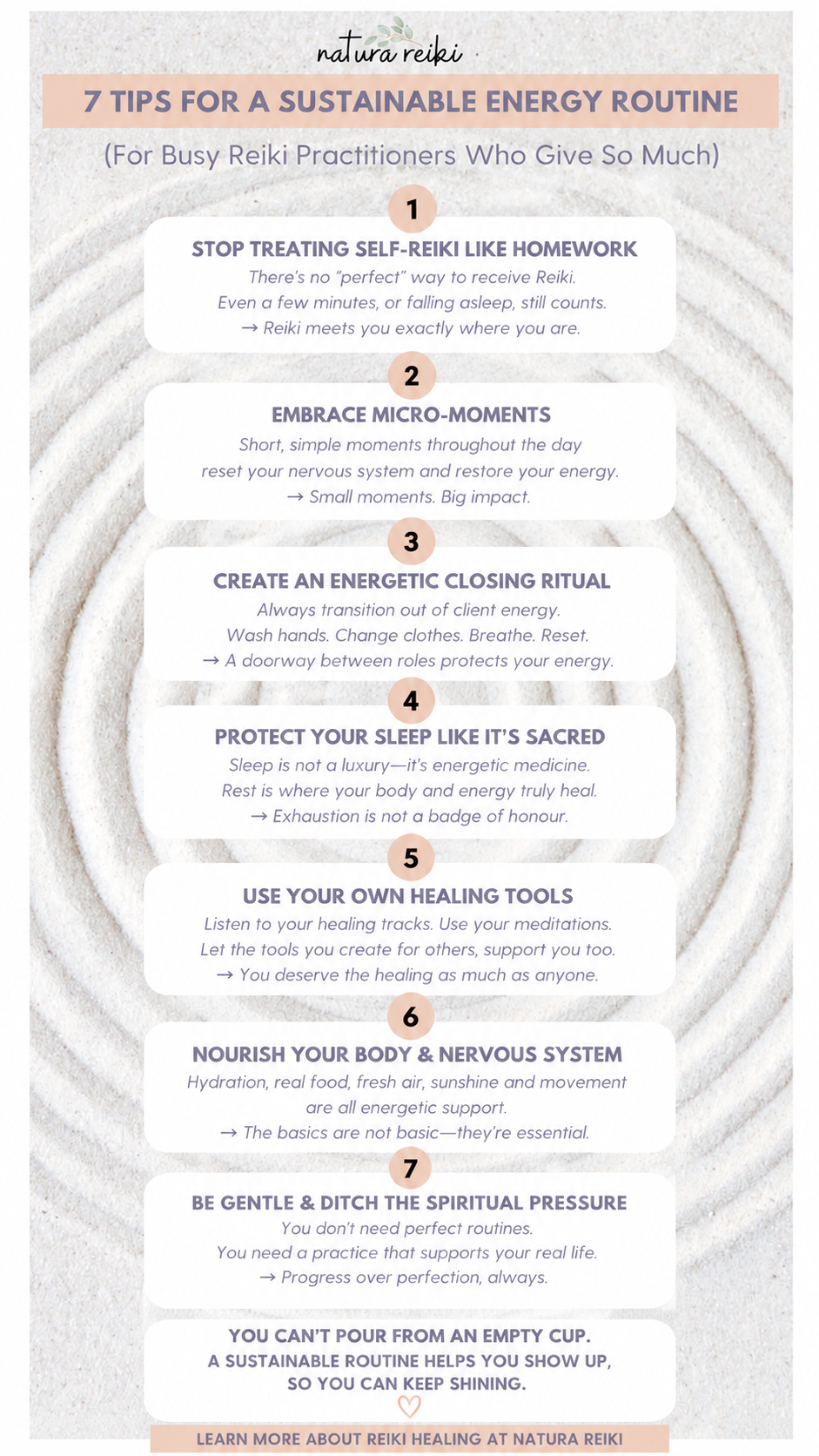
I created this infographic as a gentle reminder that your energy matters too. 🌿
You do not need a perfect spiritual routine.
You do not need to “complete” every self-Reiki session perfectly.
And falling asleep during healing doesn’t mean you failed, it may simply mean your body finally felt safe enough to rest.
These are the small, energetic shifts that help me come back to myself when life feels overwhelming, exhausting, or energetically noisy.
I hope they help you too. ✨
Further reading and research referenced in this article: